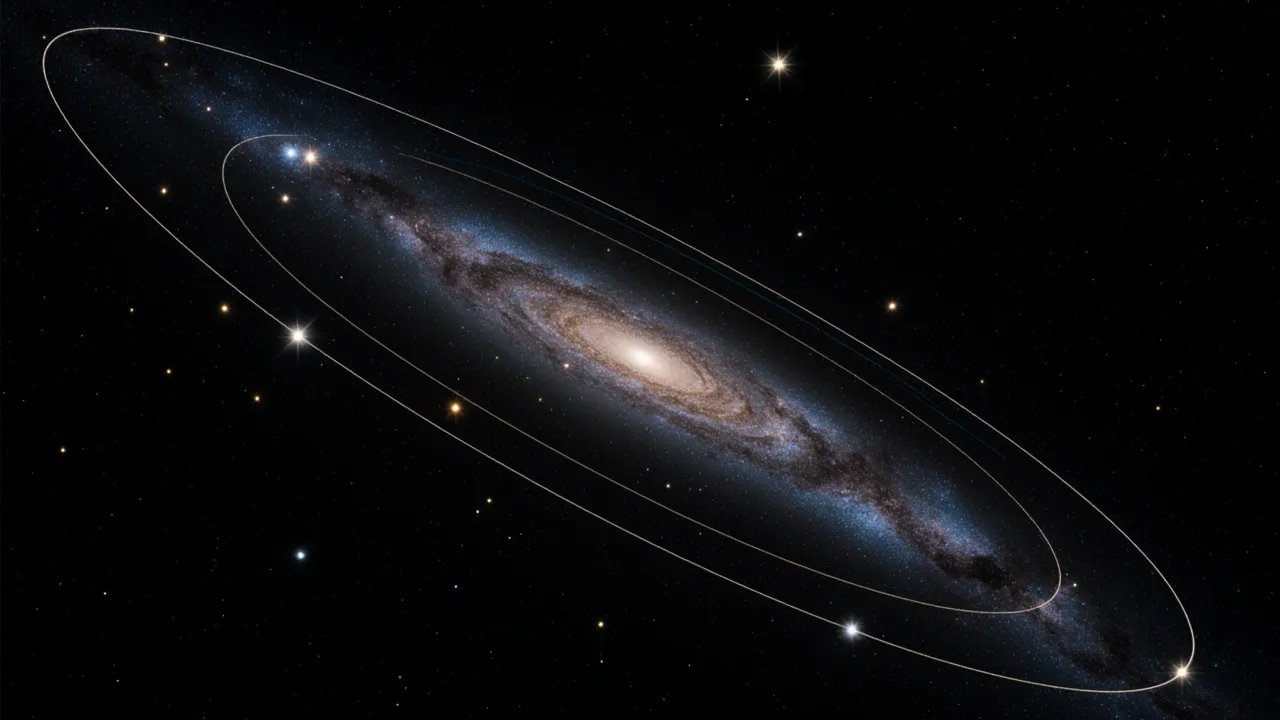
Twenty ancient stars. Two opposite orbits.
One origin. Ten billion years apart.
The Milky Way consumed a small galaxy approximately 10 billion years ago. No explosion. No remnant glow. Gravitational absorption — the parent galaxy shredded, its stars folded into the disk of our own.
Because the Milky Way was young and small at the time, its gravitational potential was weak. The merger deposited Loki's stars into two populations: prograde (orbiting with the disk) and retrograde (orbiting against it). No orderly integration. A trickster's dispersal.
For 10 billion years — longer than the Earth has existed — these stars have been moving in opposite directions through our galaxy. They are roughly 7,000 light-years from where you are sitting.
Measure the iron in any of them. The ratio will be the same. Trace the neutron star merger signatures. Identical. The orbits diverged completely. The origin did not.
The shapeshifter was consumed. Its bones are still legible.